
Key Takeaways
Accounting firm pricing pages can make the next step feel safer by:
- Give Price Context: Use starting points, ranges, tiers, or examples instead of hiding all pricing.
- Explain the Process: Show prospects what working with the firm will actually feel like.
- Clarify Fit: State who the firm serves well and who may be better suited elsewhere.
- Soften the CTA: Define a small, specific first step so reaching out feels less risky.
Check out our custom web design for accounting firms.
Most accounting firm pricing pages are trying to avoid an awkward conversation.
That’s understandable. Nobody wants a prospect to skim one number, decide the firm is too expensive, and leave before they understand the value. Nobody wants competitors copying the pricing model. Nobody wants to turn a complex tax planning relationship into a menu item.
But here’s the problem: when an accounting firm hides every pricing detail, the prospect doesn’t feel protected. They feel blind.
They don’t know whether they’re looking at a $500 conversation, a $5,000 engagement, or a $25,000 relationship. They don’t know whether the firm works with companies like theirs. They don’t know whether the first call will be helpful or whether it’ll turn into a high-pressure sales pitch.
So they wait.
Or they open another tab.
That’s the real risk. Vague pricing, vague process, and vague fit language don’t keep the wrong people away. They often keep the right people from feeling safe enough to start.
“The goal is to de-risk the call so someone is willing to engage.”
~Tim Woda, White Peak Marketing, SEO & Web Design
That line is the center of the whole article. Pricing, process, and fit language should make the right prospect feel safer. If the page makes them feel judged, trapped, or completely in the dark, the page isn’t doing its job.
Pricing Doesn’t Have to Mean Publishing Every Number
There’s a middle ground between hiding everything and turning your accounting services into a flat menu.
That middle ground is where most accounting firm pricing pages should live.
You don’t have to publish every hourly rate, every monthly fee, every fixed-fee package, every payroll add-on, every bookkeeping tier, and every possible tax planning scenario. That would probably create more confusion than clarity.
But you can give the prospect enough context to understand whether a conversation makes sense.
That might look like:
The point isn’t to lock yourself into a quote before you’ve seen the work. The point is to lower the anxiety enough that a strong prospect feels okay reaching out.
That’s especially true for tax planning. A serious tax planning prospect isn’t always looking for the cheapest accountant. They’re often trying to avoid mistakes, reduce risk, improve cash flow, protect profitability, or make better decisions before the next tax deadline. If your page only says, “Every business is unique,” you haven’t helped them think.
You’ve just restated the thing they already know.
The Three Pricing Mistakes That Make Prospects Work Too Hard
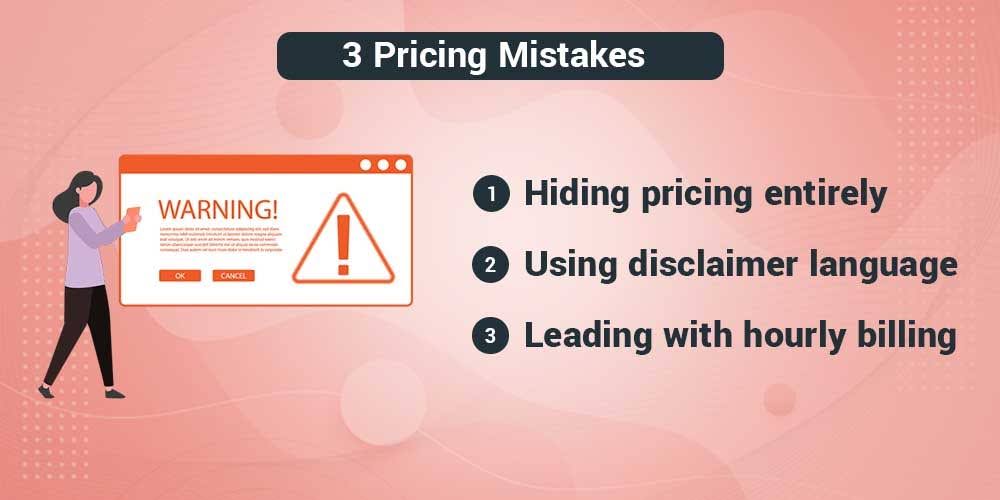
Accounting firm pricing usually goes wrong in one of three ways.
The first mistake is hiding pricing entirely.
Firm owners often do this because they worry that competitors will see their pricing strategy or that prospects will judge them solely on price. That fear isn’t ridiculous. Some prospects will judge on price alone.
But that usually happens when the rest of the page hasn’t explained value.
If the page doesn’t show who the firm is for, what level of service the client gets, what problems the firm solves, or how the process works, then yes, a number will get judged in isolation. That isn’t really a pricing problem. It’s a value-communication problem.
The second mistake is using disclaimer language that sounds responsible but tells the prospect almost nothing.
“Every business is different.”
“Pricing depends on your needs.”
“Contact us for a custom quote.”
None of that’s wrong. It’s just not enough. A prospect already knows their accounting needs are different from someone else’s. What they need is a useful boundary. Are we talking about a small monthly bookkeeping engagement? A more involved monthly accounting relationship? A tax planning strategy for a company with several entities? A cleanup project before a new pricing model even makes sense?
Give them a lane.
The third mistake is leading with hourly billing.
Hourly pricing has its place. Some compliance work is hard to scope. Some advisory projects are messy. Some accounting practice management realities don’t fit neatly into a fixed fee. We don’t need to pretend every service can be packaged perfectly.
But a public list of partner hourly rates can send the wrong signal.
To a cautious buyer, hourly-rate pricing can feel as if the firm is rewarded for taking longer. That may not be true. It may not be fair. Still, perception matters. If the page says “$350 per hour” but doesn’t explain the expected scope, the client experience, or the value of the work, the prospect starts doing nervous math.
They picture an invoice they can’t predict.
That isn’t a great emotional state for conversion.
Pricing page pattern | What the prospect may hear | Better move |
No pricing context | “I might be wasting my time.” | Give a starting point, range, or scope-based example. |
Heavy custom-quote disclaimers | “They won’t tell me anything until I call.” | Explain what changes the price and why. |
Public hourly rates with no scope | “This could turn into an unpredictable invoice.” | Pair hourly billing with expected scope or alternatives. |
Generic packages | “These tiers don’t reflect my situation.” | Tie each tier to a real client need or level of service. |
The table doesn’t replace the pricing conversation. It just shows the pattern: the page has to translate pricing into confidence.
Better Pricing Language Gives the Prospect a Handrail
The best accounting firm pricing strategy for a website isn’t always the same as the firm’s internal pricing method.
Internally, you may think in hourly billing, fixed-fee pricing, value-based pricing, subscription pricing, project pricing, or some blend of all of those. Fine. That’s the business model conversation.
The website has a different job.
The page’s job is simpler: present pricing in a way a buyer can understand. If you’re trying to price accounting work on your website, price your services by scope, risk, value, and level of service. Don’t just copy what another high-performing accounting firm does.
You also don’t need to go overboard. Most prospects aren’t looking for a textbook on accounting pricing. They’re trying to decide whether they can trust you with their situation.
That’s why strategic pricing needs plain-language presentation. Done well, it can help you grow your accounting practice without filling the client roster with work you should have filtered out sooner.
It needs to help the prospect understand what kind of investment they may be walking into and why that investment makes sense.
That might sound like:
- “Monthly bookkeeping starts at $750 for owner-led businesses with clean records.”
- “Tax planning engagements typically begin at $2,500 and vary based on entity structure, income sources, and planning complexity.”
- “Our advisory packages are built around three tiers, so you can choose the level of support that matches your decision-making needs.”
- “If your books are behind, we will quote cleanup separately before moving you into a monthly price.”
- “If we aren’t the right fit, we’ll tell you and point you toward a better option.”
Even if a bookkeeper handles the day-to-day monthly bookkeeping, the prospect still needs to know how that work fits into the bigger accounting relationship. Are they paying for task completion, owner guidance, tax planning support, or all three? That’s the difference between a price list and a pricing page that actually helps someone decide.
Notice what those lines do.
They don’t promise the exact right price before discovery. They don’t turn a complex accounting business into a cheap template. They don’t pretend a micro business and a mid-market company need the same level of support.
They just make the next step less foggy.
That’s what good pricing options should do.
Three Tiers Can Help, But Only If the Tiers Mean Something
The three-tier pricing structure is common for accounting and bookkeeping firms. It can work. It can also become another generic table nobody believes.
The middle option, or middle tier, is usually where price anchoring shows up. The lowest tier looks too light. The highest tier feels too much. The middle tier starts to feel like the sensible choice.
There’s nothing wrong with that if the tiers are honest.
But the tiers should be built around real differences in client need, not cute package names.
For example:
- A basic tier might work for clean monthly bookkeeping services and simple reporting.
- A growth tier might add payroll coordination, monthly accounting review, and cash flow support.
- A strategic tier might include tax planning, entity planning, owner meetings, and advisory work.
That’s more useful than Bronze, Silver, and Gold with the same vague bullet points repeated three times.
A good tier helps the prospect self-select. A weak tier makes them feel like they’re being nudged.
This is where value pricing for accountants can be powerful, but only if the value is explained in plain language. “Price based on the value” sounds nice inside a pricing strategy meeting. On the page, the prospect needs to see what value actually means.
Less time spent chasing reports.
Cleaner books before tax season.
More useful owner meetings.
Fewer surprises when tax planning decisions need to be made.
Better visibility into cash flow.
That’s the language a client can feel.
Don’t Fall Into the Chevron Trap
Process sections can be just as vague as pricing sections.
You’ve seen the graphic. Four chevrons in a row. Discovery. Analysis. Implementation. Review.
There’s nothing offensive about it. That’s almost the problem. It’s so safe and familiar that the visitor glides right past it.
Most accounting professionals do have a process. The issue is that they describe it from the firm’s side of the desk.
“We reconcile accounts weekly.”
“We review your financial data.”
“We prepare your invoice.”
“We use accounting software to streamline billing and reporting.”
Again, not wrong. Just not very persuasive.
The client is asking a different question: “What will this feel like for me?”
So tell them.
Firm-centered process language | Client-centered process language |
“We reconcile accounts weekly.” | You won’t spend Friday afternoon cleaning up transactions before payroll. |
“We review your financial information.” | You’ll know which numbers we need, when we need them, and what happens if something is missing. |
“We use modern accounting software.” | You’ll have one clear place to upload documents, approve questions, and see what’s waiting on you. |
“We handle onboarding.” | In the first 30 days, we’ll sort out what’s messy, missing, urgent, and unclear. |
The left side may be technically true. The right side answers the question the prospect actually cares about.
That’s process language a prospect can understand.
It isn’t just workflow. It’s relief.
Show the Messy Part of the Process, Too
Many accounting firm websites describe a perfect client.
The client sends every file on time. The books are clean. The documents are organized. The payroll records are easy. The prior accountant left everything in good shape. The business owner knows exactly what they need.
Lovely.
Also, not always real life.
Some prospects are late because they’re overwhelmed. Some are embarrassed because their bookkeeping is messy. Some have been avoiding the issue because they expect to be scolded. Some know they need a CPA, but they don’t know whether they need tax prep, tax planning, cleanup, payroll help, monthly accounting, or all of it.
If your process page assumes everything is neat, those prospects may quietly disappear.
This is where a simple 30-day onboarding outline can do more than another process graphic.
For example:
- Week 1: We learn what is messy, missing, urgent, or unclear.
- Week 2: We review access, documents, accounting software, and past filings.
- Week 3: We identify cleanup needs, planning opportunities, and priority deadlines.
- Week 4: We confirm scope, pricing, responsibilities, and next steps.
That kind of process doesn’t shame the prospect. It tells them you’ve seen imperfect situations before.
You can even say it plainly:
“You don’t need to clean up your books before we talk. Bring us your mess exactly as it is.”
That sentence will do more conversion work than half the chevrons on the internet because it names the anxiety the prospect is already carrying.
Fit Language Is Where Good Prospects Start to Relax
Pricing and process get attention, but fit may be the most important part.
Many accounting firm websites say they serve individuals, small businesses, corporations, and nonprofits. That may be true. It also tells the prospect almost nothing.
If you serve everyone, the visitor has to figure out whether you really serve someone like them.
That’s where “is this you?” language helps.
You can say:
“We’re a good fit for business owners who want proactive tax planning, clean monthly reporting, and fewer surprises.”
You can also say:
“We’re probably not the right fit if you only need the lowest-cost tax return and don’t want ongoing guidance.”
That second sentence may feel scary to firm owners. It shouldn’t. It’s doing useful filtering without sounding cold.
Clear fit language helps the ideal client feel seen. It also gives the wrong client a graceful way out.
And frankly, that’s better for everyone.
“Not a Fit” Language Can Make the Right Person More Likely to Call
Here’s the strange thing about fit language: saying who you aren’t for can make the right prospect trust you more.
It shows you have a point of view.
It shows you aren’t trying to turn every visitor into a client.
It also lowers the fear of being trapped in a sales conversation. If the page says, “If we aren’t the right fit, we’ll introduce you to a firm that is,” the prospect hears something different.
They hear, “This won’t be a hard sell.”
That matters because a lot of tax planning prospects are already nervous. They may be worried their financials are disorganized. They may be worried they waited too long. They may be worried the accountant will make them feel foolish. They may be worried the price will be wildly outside their budget.
Good pricing pages acknowledge that tension without overdramatizing it.
The page can say:
“If you aren’t sure whether you need tax planning, tax prep, cleanup, or monthly accounting, that’s okay. The first call is built to help you sort that out.”
That’s simple. It’s human. It doesn’t sound like a template.
“A confused mind always says no.”
~Tim Woda, White Peak Marketing
That is why the page has to make fit easier to understand. If someone isn’t sure whether they’re the kind of client you help, they may not ask. They’ll just leave.
The CTA Shouldn’t Feel Like a Trap

“Book a consultation” sounds normal to the firm.
To the prospect, it may sound bigger than you think.
They may picture a long Zoom call. A pitch. A partner telling them their books are a disaster. A conversation they can’t gracefully exit.
That’s why pricing pages often need a softer, more specific next step.
Try language like:
The time boundary matters. A strict 15-minute Zoom call feels different from an open-ended consultation. “No pitch, just diagnostics” feels different from “Contact us.”
You can also show the agenda:
“On this call, we’ll look at your last tax return, identify two immediate planning areas, and let you know whether we can help. If we’re a fit, we’ll give you a clear next step and an exact price quote.”
That isn’t aggressive. It’s useful.
It tells the prospect what will happen before they hand over their contact information.
How White Peak Thinks About Pricing Pages
White Peak isn’t interested in making accounting firm websites that only look nice.
A pretty website that doesn’t convert is still a problem.
Yes, traffic matters. SEO matters. A clean design matters. The site should look professional, load well, and support the firm’s brand. But for an accounting firm, the page still has to do the harder job: it has to make the right person feel safe enough to take action.
That’s why pricing, process, and fit pages matter so much.
They sit right where hesitation tends to happen.
The prospect is interested, but not sure.
They have a need, but not enough confidence.
They may be a strong potential client, but they don’t want to walk into an unknown price, unknown process, or unknown sales conversation.
So the page needs to de-risk the next step.
That doesn’t mean every accounting firm should publish a full pricing table. It doesn’t mean every CPA should abandon hourly billing, move to fixed fee pricing, or adopt value-based pricing tomorrow. It doesn’t mean there’s one right pricing model for every accounting practice.
It means the website should explain enough that the prospect can move.
That’s the conversion work.
A Simple Pricing, Process, and Fit Checklist
Before you publish or rewrite an accounting firm pricing page, ask a few honest questions.
Can the prospect tell the difference between your service levels?
Can they understand what drives the price?
Can they see whether you’re a fit for their company size, accounting needs, or tax planning situation?
Can they tell whether you use hourly billing, fixed-fee pricing, subscription pricing, or a custom pricing structure?
Can they understand what happens before they become a client?
Can they see what happens if their books are messy or their documents are late?
Can they take a small next step without feeling trapped?
If the answer is no, the page is probably asking for too much trust.
That’s fixable.
FAQs About Accounting Firm Pricing Pages
Should accounting firms publish pricing on their website?
Accounting firms don’t have to publish every price, but they should usually give prospects some useful pricing context. Starting points, ranges, tiers, or sample scenarios can help the right prospect understand whether a conversation makes sense.
Is hourly billing bad for accounting firms?
Hourly billing isn’t automatically bad. The problem is how it feels to the buyer when it appears without scope, value, or expectation-setting. If you list an hourly rate without explaining what the work includes, the prospect may worry about an unpredictable invoice.
What is value-based pricing for accountants?
Value-based pricing means the price is based on the value of the outcome, not only the hours worked. On a website, it should be explained in client language: better cash flow visibility, fewer tax surprises, cleaner reporting, or stronger planning decisions.
Should accounting firms use three pricing tiers?
Three tiers can work when each tier reflects a real level of service. They work less well when the tiers are just a pricing template with vague package names and repeated bullet points.
What should a pricing page say before asking someone to book?
It should explain who the firm is for, what affects pricing, what the first step includes, how long the first call takes, and what happens if the firm isn’t the right fit.
Make the Next Step Feel Safer
Your pricing page doesn’t need to answer every possible pricing question.
It needs to answer the questions that keep a good prospect from moving.
Can I afford this?
Will they understand my situation?
Will they pressure me?
Will I be embarrassed if my books are messy?
Will the process be clear?
Will I know what I’m paying for before I commit?
When the page answers those questions, pricing becomes less scary. Process becomes less abstract. Fit becomes easier to recognize.
That’s when the right prospect is more likely to reach out.
White Peak builds websites for CPAs and accountants with that conversion path in mind. If your accounting firm website looks professional but leaves prospects guessing about price, process, or fit, we can help make the next step clearer.