Key Takeaways
- Clean up conflicting tax pages before adding new ones.
- Judge every URL by traffic, links, relevance, and conversions.
- Keep, refresh, merge, or remove each page based on evidence.
Explore our website design services for CPAs and accountants.
When an accounting firm decides to add tax planning pages, the instinct is usually to start writing. A new service needs a new headline, fresh copy, a polished layout, and a prominent call to action.
That may be the right destination, but it is not always the right starting point.
A new page cannot fix an accounting firm website that still contains conflicting tax-service descriptions, stale legislative articles, generic proof, abandoned niche pages, or a contact path that barely works on a phone. In that situation, adding more content may make the site larger without making it clearer.
Accounting firm page cleanup comes first because the new tax-planning page needs a distinct role. The existing site must make it obvious where tax preparation ends, where planning begins, why the firm is credible, and what a prospective client should do next.
Why Can New Tax Planning Pages Make a Messy Website Worse?
A well-written page does not live in isolation. Visitors move from it to your About page, service pages, proof, team bios, contact form, and navigation. Search engines also evaluate the page within the broader structure of the site.
That means a strong new page can still inherit old problems.
Suppose your firm launches a tax planning page focused on forward-looking decisions, entity structure, timing, and long-term financial strategy. The navigation still includes an older page called “Tax Services,” another called “Tax Preparation and Planning,” and three blog posts that each describe the same service in slightly different language.
The new page has not clarified the offer. It has joined a crowded argument about which page matters most.
The same problem appears on the conversion side. A new page may clearly explain tax planning, but the shared contact form requires 10 fields, financial details, and a document upload before the visitor can ask a basic question. The copy creates confidence, then the website takes it away.
“Building new pages on top of a broken structural foundation is a waste of time.”
~Tim Woda, White Peak Marketing
The point is not that every older page should disappear. It is that expansion should follow a deliberate review of what the site already says, how those pages perform, and whether they still support the firm you are trying to become.
What Should an Accounting Firm Clean Up Before Adding Pages?
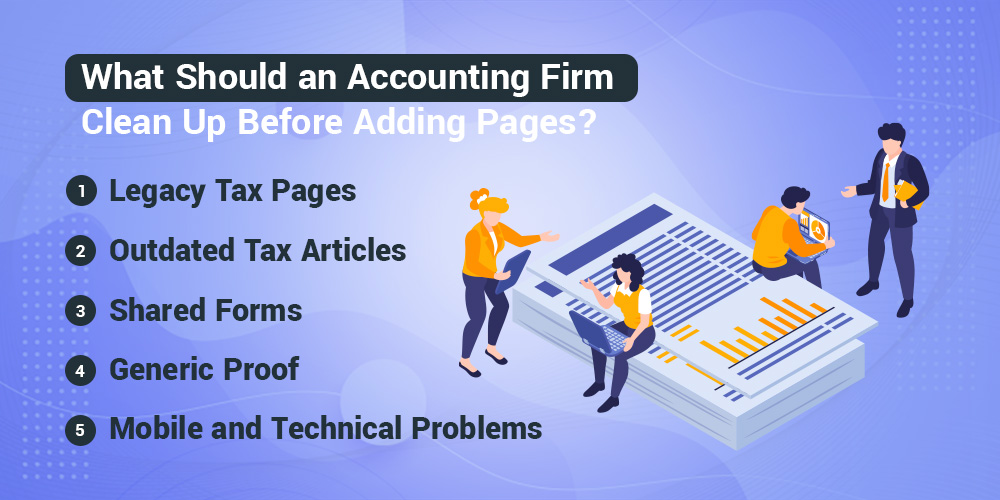
The cleanup should begin with problems that can undermine the new page across the entire website. Five patterns show up repeatedly.
Legacy Tax Pages That Blur Preparation and Planning
Tax preparation and tax planning are related, but they are not interchangeable.
Tax preparation is primarily backward-looking. It deals with completed transactions, financial records, filings, compliance, accuracy, and events that have already occurred during the tax year.
Tax planning is forward-looking. It helps a client consider timing, structure, future decisions, risk, and potential opportunities before those decisions become fixed.
An older accounting firm website often compresses both into a broad “Tax Services” page. That may have seemed efficient when the site was smaller. Once the firm wants to promote planning as a distinct service, the vague page becomes a structural problem.
Start by mapping every page that discusses tax preparation, tax compliance, tax strategy, advisory work, and tax planning. Look for duplicated promises, headings that target the same need, and pages that force the reader to guess which service applies.
The answer is not automatically to delete the oldest page. One URL may already have useful traffic, relevant backlinks, or a history of producing inquiries. The job is to decide which page should own each intent, preserve the strongest asset, and remove the ambiguity.
Outdated Tax Articles and Fragmented Content
Accounting firms tend to keep old tax alerts because someone invested time in writing them and no one wants to remove something that might still have value.
That caution is understandable. It also creates digital clutter.
A detailed article about an expired relief program, an old filing threshold, or a superseded tax rule may no longer help the current reader. A cautious prospect can land on the article through search, notice that it is years out of date, and wonder what else the firm has neglected.
Don’t just focus on age when assessing an article’s value. Even if an article is older, it can still draw traffic, gain links, or offer important historical insights. Take some time to check whether the information is still accurate, whether the content meets a current search need, and whether it can be refreshed without altering its main intent.
Pages that cannot be made current should be retired deliberately. When an old URL has a clear replacement, a permanent redirect can send visitors and search engines to the more relevant destination. When no replacement exists, and the page has no remaining value, removal may be appropriate. Google’s documentation on redirects and removed pages can help your team handle those technical decisions correctly.
Shared Forms That Create Too Much Friction
A new tax planning page usually relies on the same inquiry system as the rest of the site, and that’s where the real issue might be lurking. While the page encourages visitors to set up a brief chat, the form requires a lot of information. It asks for details like revenue, entity type, employee count, specific tax concerns, preferred services, and multiple document uploads.
Honestly, that feels like quite a bit of homework just to get started!
Before adding another page to the site, review the first interaction across desktop and mobile. A visitor should be able to ask for help without having to clean up their books, find three years of records, or complete a full financial profile first.
The deeper strategy for accounting firm website forms belongs in its own article. For this cleanup, the question is simpler: does the existing form support the promise made by the new page, or does it create a wall at the moment the visitor is ready to act?
Generic Proof That Cannot Support Advisory Trust
Tax planning requires more confidence than a generic “We provide excellent service” statement can create.
Many firms have testimonials, but the proof is buried on a separate page or reduced to short comments such as “Great firm” and “Very professional.” Those statements may be sincere, yet they do not show how the firm thinks, what type of client it helps, or why someone should trust it with a more complex planning need.
Before launching the new page, identify proof that is specific, relevant, client-approved, and safe to publish. That may include a named testimonial, an anonymized scenario, a clearly described process, a niche credential, or a measurable result the firm can document and substantiate.
Do not manufacture precision. A detailed-sounding claim is not stronger proof when the firm cannot verify it. The goal is to replace vague praise with credible context, not to turn every client relationship into a dramatic case study.
Mobile and Technical Problems That Block Action
Some problems are invisible during a planning meeting because the page looks fine on a desktop monitor.
The phone number may not be tappable. A sticky header, cookie notice, and chat widget may cover much of the mobile screen. The navigation may push important services below several layers of menus. A contact form may break when the keyboard opens.
A new page will inherit these global problems.
The article on accounting firm mobile UX explains small-screen friction in depth. During page cleanup, focus on the shared barriers that affect every new page: navigation, footer, forms, tap targets, phone links, overlays, and page templates.
Which Pages Create the Most Clutter?
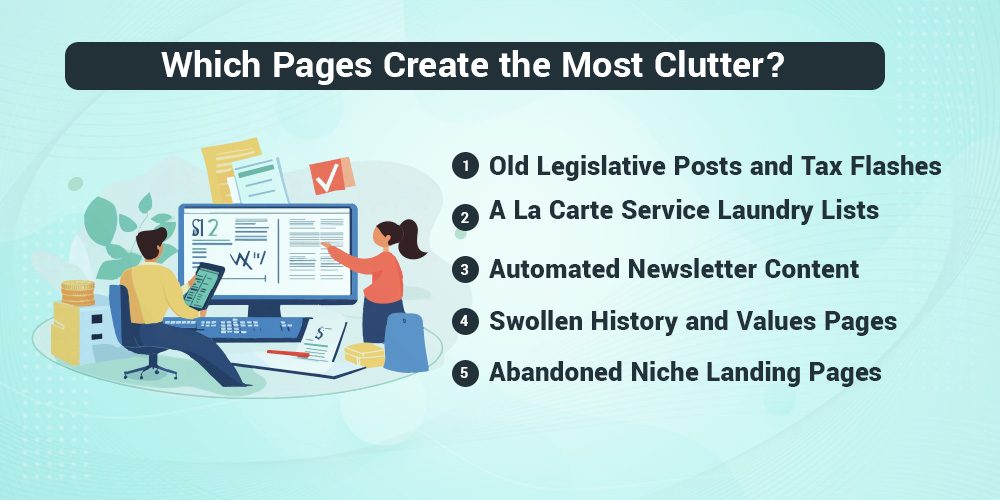
When it comes to accounting firms, you might notice that some of their web pages can get pretty cluttered. This often happens because firms are hesitant to remove old content. With busy partners juggling numerous tasks and the complexities of compliance to consider, keeping an outdated page seems easier than deciding to delete it.
Over time, that caution turns the website into a digital attic.
“Accounting websites often become digital attics filled with outdated compliance articles, abandoned marketing experiments, and repetitive service descriptions.”
~Tim Woda, White Peak Marketing
The following page types deserve a closer look before the site expands.
Old Legislative Posts and Tax Flashes
Tax alerts are useful when they are timely, accurate, and connected to a real client question. They become a liability when the site presents old rules as though they still apply.
Take a look at the tax flashes to check the dates, thresholds, program status, source links, and any language that suggests a temporary rule is still in effect. Make updates to the pages that still provide value. Consider consolidating several brief updates into a single comprehensive resource to improve the reader’s experience. If there’s content that can’t be trusted without a complete overhaul, it’s best to retire it.
A La Carte Service Laundry Lists
A long list of every accounting service can make a firm look capable at first glance. It can also make the visitor do all the sorting.
When bookkeeping, payroll, tax preparation, tax planning, outsourced accounting services, advisory work, financial reporting, and business consulting are packed into a single page, the reader cannot tell which service addresses the immediate problem.
The cleanup decision is not necessarily to create a separate page for every line item. Group services by buyer need and intent. Preserve distinctions that matter to the client. Remove repetitive descriptions that say the same thing in different places.
Automated Newsletter Content
Some accounting websites publish third-party articles automatically to keep the blog active. The result is often a steady stream of technical content that does not sound like the firm and was not written for its clients.
An article about a narrow depreciation provision may be accurate, but that does not mean it helps a business owner understand what to do next. When the feed contains no White Peak-style explanation, no firm perspective, and no connection to the services offered, volume becomes a substitute for usefulness.
Review whether syndicated content attracts the right audience, strengthens trust, and reflects the firm’s expertise. If it does none of those things, keeping the feed active may create more noise than authority.
Swollen History and Values Pages
Firm history matters when it helps the prospect understand continuity, experience, local roots, or the people behind the work.
It becomes self-centered when the page devotes thousands of words to office moves, partner transitions, and generic values such as integrity, excellence, and trust, without connecting those ideas to the client’s situation.
Basic integrity is expected of a CPA firm. A values page earns its place when it shows how those values affect communication, deadlines, decision-making, confidentiality, or service. Trim the corporate autobiography, keeping the parts that make the firm easier to understand and trust.
Abandoned Niche Landing Pages
A niche page may have been created after the firm won one client in a particular industry or attended a networking event. Years later, the page still exists even though the firm never developed a meaningful specialty.
Prospects can see the gap.
A page titled “Accounting for Dentists” does not establish niche expertise when the copy is a generic service page with the industry name swapped into a few headings. Without relevant examples, tailored concerns, specialized processes, or credible proof, the page can weaken the firm’s authority.
Keep the page when the niche remains strategically relevant, and the firm can support the claim. Improve it when the expertise is real but poorly communicated. Consolidate or remove it when the page represents an abandoned experiment.
The Four-Evidence Page Decision Framework
Page cleanup should not be driven by preference, fear, or the loudest partner in the room. At White Peak, we evaluate existing URLs through four evidence categories:
Traffic: Are people finding and using the page?
Backlink equity: Do credible external sites link to it?
Topical relevance: Does the page match the firm’s current services, audience, and positioning?
Conversions: Does the page contribute to calls, forms, bookings, or another meaningful action?
These signals do not automatically make the decision. They force the team to discuss the page using evidence rather than sentiment.
| Page category | Evidence pattern | Recommended action | Primary risk avoided |
| Keeper | Steady traffic, aligns with firm’s ideal client profile, valuable links, relevance, and drives conversions | Preserve the URL and use the page as a benchmark | Disrupting a page that already works |
| High-Potential Slacker | Valuable service or keyword and good link equity, but stale/outdated content, and traffic is declining | Keep the URL and overhaul the execution | Discarding an asset with potential |
| Consolidate | Several shallow pages serve the same audience and intent | Merge into the strongest page and redirect relevant retired URLs | Cannibalization and visitor confusion |
| Dead Weight | No traffic, links, conversion value, or unique information | Delete; redirect only when a true replacement exists | Index clutter and misleading content |
Keep the Strong Performer
A keeper has a clear purpose, steady organic traffic or direct use, valuable backlinks, current relevance, and evidence that it helps visitors take action.
Leave the URL alone unless there is a compelling reason to change it. Small improvements may still be possible, but do not rebuild a strong page merely because the rest of the site is being redesigned.
Treat it as a benchmark. What does it explain clearly? Which proof works? How does the visitor move from the page to the next step? Those lessons can guide the new tax planning content.
Improve the High-Potential Slacker
Some pages target the right service and hold useful equity, but the copy is stale, the page is difficult to use, or the information no longer reflects how the firm works.
Keep the URL and improve the asset.
Rewrite technical jargon into buyer-centered language. Update outdated claims. Add specific proof. Clarify who the service is for. Make the next step easier on a phone. Link the page to the correct place in the buyer journey.
This is also where pricing, process, or fit language may need refreshing. The sibling article on that topic can guide the deeper messaging decisions.
Consolidate the Overlapping Competitors
Several shallow pages often compete for the same intent.
You may find separate pages for tax services, tax compliance, business tax, strategic tax, tax consulting, and tax planning, each containing similar paragraphs. Keeping all of them does not necessarily create more coverage. It can create uncertainty about which page is authoritative.
Choose the strongest URL based on performance, links, relevance, and conversion value. Merge the best useful information into that page. Then redirect the retired URLs to the surviving destination when the replacement is genuinely relevant.
The purpose is not merely to reduce the page count. It is to give one page a clear job and enough depth to perform it well.
Remove the Dead Weight
Dead weight has no meaningful traffic, no useful backlinks, no strategic conversion role, and no unique information worth preserving.
That page does not need to survive because someone remembers approving it seven years ago.
Remove it carefully. Use a relevant redirect only when a true replacement exists. Sending every retired URL to the homepage creates a confusing experience and may not be treated as a meaningful replacement. When a page is simply gone, and no equivalent exists, an appropriate not-found or gone response allows the site to communicate that clearly.
What Should You Do Before Writing the New Tax Planning Page?
Once each page has a category, the cleanup becomes a sequence rather than a debate.
1. Map the existing tax, advisory, bookkeeping, and niche-service URLs.
You do not need a massive content-audit spreadsheet to begin. Start with the pages most likely to overlap with tax planning and with the global elements used on every service page.
2. Separate tax preparation intent from tax planning intent.
Write a one-sentence job description for each future page. The preparation page should help someone who needs accurate filing and compliance. The planning page should help someone considering forward-looking decisions. When both descriptions sound the same, the structure is not ready.
3. Evaluate the existing URLs with the four evidence categories.
Use analytics, search performance, backlink information, lead tracking, and current business priorities. No single metric tells the whole story.
4. Preserve the pages that already work.
Do not let a broad redesign erase strong URLs or proven conversion paths.
5. Refresh pages with a valuable purpose but weak execution.
Update the copy, proof, calls to action, and mobile experience while retaining the URL, as it remains the correct destination.
6. Consolidate repetitive pages into a clear canonical destination.
Merge useful information, remove duplication, and redirect retired URLs only to closely relevant replacements.
7. Retire content that no longer serves the reader or the firm.
Old tax alerts, abandoned niches, automated articles, and generic service fragments should not remain by default.
8. Repair the shared path to action.
A new service page cannot succeed when the sitewide form, navigation, phone links, or booking path remains broken. Review consultation booking and lead quality before sending more visitors into the same system.
9. Design the new page around its distinct role.
After cleanup, the service page layout can focus on tax planning intent without repeating tax preparation, generic accounting services, or every capability the firm offers.
Should an Accounting Firm Delete Old Tax Articles?
Not automatically.
An old article may still be accurate, attract relevant traffic, earn backlinks, or answer a question clients continue to ask. Update it as long as the purpose remains useful. Consolidate it when several pages repeat the same answer. Remove it when the information is no longer reliable, and there is no worthwhile reason to preserve the page.
What Is the Difference Between Tax Preparation and Tax Planning Pages?
Tax preparation pages address filing, compliance, completed financial activity, and accuracy. Tax planning pages address future decisions, timing, structure, and strategy.
The distinction should be visible in the page’s headline, examples, proof, process, and next step. Changing only the title while repeating the same body copy does not create a meaningful difference.
When Should Two Accounting Service Pages Be Consolidated?
Consolidation makes sense when two pages target the same audience, answer the same question, describe the same service, and compete for the same action.
Keep separate pages when the buyer intent, service process, proof, or next step is genuinely different. The decision should follow the four evidence categories rather than page length alone.
Should a Page With No Traffic Always Be Deleted?
No.
A page might serve a niche but important audience, helping specific visitors who find it through navigation. It can clarify a necessary service or play a role in conversions that might not be expected. If you’re seeing zero traffic, think of it as a red flag rather than a final judgment.
Check relevance, links, conversions, and the page’s role before deciding.
What Should Happen to an Old URL After Its Content Is Removed?
Use a permanent redirect when a closely relevant replacement satisfies the same need. Do not redirect unrelated pages merely to avoid a 404.
If no suitable replacement is available, use a standard page-not-found response. It’s a good idea for your developer or SEO partner to implement this decision in a way that aligns with the latest search engine guidelines, and they should test it thoroughly.
How Do You Know Whether a Niche Accounting Landing Page Is Worth Keeping?
Ask whether the firm still wants the audience, understands its specific problems, has a tailored service process, and can show credible evidence of experience.
A niche label is not enough. The page should contain insight that would not apply equally to every industry. When the firm cannot support the specialization, the page may be better consolidated into a broader service page.
Clean Things Up Before Expanding Your Site
Before you dive into adding new tax planning pages to your website, take a moment to tidy things up first. It might seem like more content will clear up any confusion that’s accumulated over the years, but that’s not always the case.
Start by cleaning up any outdated tax pages and reviewing articles that may no longer be relevant. Make it easy for your visitors to get in touch by streamlining the contact process. Building trust in your advisory services is crucial, so gather evidence that showcases your expertise.
Also, don’t overlook the mobile experience. Once you’ve made those improvements, step back and assess what you have: Which content should stay as is? What needs a little tweaking? What can be merged? And importantly, what can you part ways with altogether? By taking these steps, you’ll establish a strong foundation for your website’s growth, giving those new pages the space they need to shine.
White Peak helps accounting firms turn crowded, outdated websites into clearer buyer journeys. Our accounting firm website redesign help can include the cleanup, structure, and page planning needed before your firm adds another layer of content.