
When firms start thinking about SEO, they often chase the biggest numbers they can find. That is how many teams end up targeting broad terms, watching traffic rise and wondering why nothing changes in the pipeline. The smarter play with long tail keywords for accountants is different. You are not trying to attract everyone who types a vague query into search engines. You are trying to reach the searcher who already knows the problem, wants a provider and is much closer to action.
That shift changes everything.
A broad keyword like accountant can bring in students, job seekers, people comparing accounting software, or owners who are still trying to understand basic options. A long-tail keyword can reveal a much narrower need, a clearer buying window and a stronger fit for your accounting firm. When you stop obsessing over raw search volume and start reading search intent, you stop building for empty traffic and start building for qualified demand.
In our broader guide to how SEO works for accounting firms, we explain how keyword strategy, trust, site structure and conversion all connect. This article zooms in on one piece of that system: why targeting long-tail searches often does more to attract more qualified leads than chasing giant head terms ever will.
Key Takeaways
Buyer-focused accountant SEO wins:
- Intent beats volume: Buyer-ready queries convert better.
- Specific modifiers qualify: Service, niche and city terms sharpen fit.
- Map by page type: Transactional terms belong near conversion.
- SEO works as a system: Keywords need trust, UX and structure.
Check out How SEO Works for Accounting Firms: A Full Breakdown.
Why Long Tail Keywords for Accountants Beat Broad Traffic
A long-tail keyword is not just a longer phrase. It is one of the keywords that tells you more about what the searcher wants, how urgent the need may be and what kind of page should answer the query.
That is why keywords are more specific phrases with so much commercial value.
Someone typing “accountant” could mean almost anything. Someone typing “small business accounting services in Reno” is giving you a service type, an audience and a location in one move. Someone searching “expert tax preparation services for contractors” is signaling a need that can map to a high-intent page. Someone comparing the right accounting software may not need an accounting firm at all.
This is where long tail keywords start doing real work. They filter out loose interest and pull in people searching with more context. In plain terms, they help search engines understand who the page is for, and as Google’s SEO Starter Guide explains, SEO is about helping search engines understand your content, and helping users find your site and make a decision about whether they should visit your site through a search engine.
The old habit is to treat monthly search as the headline metric. That view is too shallow for accounting services. A phrase with lower monthly search can outperform a bigger term when the wording shows a transactional need, a local need, or a niche service request.
That is why long-tail terms often outperform short-tail keywords.
A search like “tax deductions” may bring in early research traffic. A search like “tax preparation services for small businesses in Sparks” points to a buyer who is actively looking. The first may support content marketing. The second belongs much closer to revenue. When you want to rank for long-tail keywords that attract buyers, you need to read the difference.
Need Long-Tail Keywords Right Away?
Check out 50 Long-Tail Keywords for Accounting, Bookkeeping and CPA Firms.
Search Intent Is Where Lead Quality Starts
Keyword strategy breaks when firms treat every query as equal. The real question is not whether a term sounds relevant. The real question is what the searcher is trying to accomplish.
That is where search intent sharpens your keyword research.
A searcher who wants definitions behaves differently from a searcher who wants quotes, timelines or a consultation. In accounting SEO, that gap matters because people searching often move from education to evaluation and then to provider selection. The wording of the search queries tells you where they are.
You can usually sort long-tail terms into a few useful buckets. Service-based phrases show direct demand for accounting services. Problem-based phrases reveal pressure, often around compliance, cash flow, cleanup work or deadlines. Industry-based phrases point to specialization. Local search phrases show geographic relevance. Comparison phrases can signal a buyer narrowing options.
Each type of keyword tells you something different.
Consider keywords like small business accounting, outsourced CFO for dentists, payroll compliance help for restaurants, or tax preparation services near me. None of those phrases has the same meaning. One may belong on service pages. One may belong on an industry page. One may support local SEO. One may need content tailored to a specific audience before the visitor is ready for a call to action.
That is why targeting long-tail terms works. You are not just matching words. You are aligning the page with the motive behind the search. Google’s Performance report in Search Console exists for this reason. It shows which search queries are most likely to show your site, which helps you see how real search behavior lines up with the pages you already have.
Where Long Tail Keywords for Accountants Usually Show Buyer Intent

The easiest way to find long-tail keywords is to stop thinking in abstract SEO language and start reading queries like buyer signals. When a phrase includes a service, an audience, a geography, a business problem or a comparison cue, the intent gets sharper.
A search for “bookkeeping cleanup for ecommerce business” is not the same as a search for “bookkeeping.” A search for “CPA for real estate investors in Carson City” is not the same as “CPA.” A search for “tax preparation services for S corps” is not the same as “tax help.” Those are specific phrases, and specific phrases tend to tell you what the page should do.
Here is the pattern that matters. The more detail in the query, the easier it becomes to qualify the visitor before the click. That is why long tail keywords often produce better search rankings for firms that want pipeline quality, not vanity charts.
The Long-Tail Categories That Matter Most for an Accounting Firm
Service-based long-tail phrases usually sit closest to conversion. Think keywords for accountants built around tax planning, bookkeeping, audit support, payroll, outsourced CFO work, forensic accounting or advisory services. These phrases often sound less glamorous in a report, but they are usually closer to money.
Problem-based phrases can be just as valuable.
A business owner who searches “catch up bookkeeping before tax filing” or “help fixing payroll tax mistakes” is not browsing. They have a problem that needs resolution. When the page addresses that problem clearly, shows expertise and points toward the next step, you can attract more qualified visitors without inflating traffic with the wrong audience.
Industry-based phrases are another strong lane. Local accounting firms that serve contractors, medical practices, restaurants, law firms or ecommerce sellers can use keywords like small business accounting services for contractors or tax planning for dentists to show relevance that broader pages miss. This kind of optimization usually produces stronger message match, better ranking and better conversion.
Location-based phrases matter too, especially for firms that serve Reno, Sparks, Carson City, Truckee or any other defined market. Google says local results are shaped mainly by relevance, distance and popularity, so a page about local accounting needs location language that reflects how clients search, not vague corporate copy. That is also where your Google Business Profile and your site content need to reinforce each other.
Comparison and decision-stage phrases also deserve attention. Terms like “best CPA for small businesses,” “bookkeeping services vs in-house bookkeeper” or “tax accountant for LLC near me” often come from searchers who are moving through the final stretch of evaluation. They may not all belong on service pages, but they are far more valuable than traffic from broad educational terms with weak commercial fit.
“Most people in SEO (myself included) divide keywords into three main categories: head, body and the long tail.”
Why Search Volume Misleads So Many Firms
Search volume looks clean. Buyer intent does not.
That is why so many accounting marketers overvalue the wrong metrics.
A big keyword can look exciting in a spreadsheet, in Google Ads or inside tools like Semrush and Ahrefs. Yet a high-volume term can still be a poor target keyword when it attracts DIY traffic, irrelevant industries or people searching for information that will never turn into a lead. Effective keyword research means asking whether the phrase aligns with your services, your audience and your revenue model.
Keyword Planner helps you research keywords and see estimates of the searches they receive, which makes it useful for validating monthly search, search trends and related opportunities. Still, the tool will not tell you whether the keyword belongs on a blog post, a location page or a service page. It will not tell you whether the searcher wants advice, software, definitions or a firm.
That is your job.
If you are using keyword research tools, do not stop at the numbers. Put the seed terms into the search bar, scan the search results, study the search engine results pages and notice what search engine results keep appearing. Look at people also search refinements, related searches and Google’s people also ask boxes. The best SEO keywords for accountants rarely reveal themselves from one export alone.
This is not an ultimate guide to keyword research, but one point needs to land. Your page choices should be based on search intent, not just search volume. When you plug keywords into a tool, you are collecting clues. You still need judgment to decide which phrases belong on which pages.
The same goes for keyword difficulty. A keyword difficulty score can help you compare opportunities, but it does not replace judgment. Some phrases with modest competition and low search volume are worth far more than flashy terms that never convert. That is why thorough keyword research beats the lazy habit of dropping keywords into a tool and sorting by volume.
Where These Keywords Belong on Your Site
One of the biggest mistakes in SEO strategies for accountants is assuming every useful phrase belongs in blog content. It does not.
High intent and transactional keywords often belong on the pages closest to conversion.
If the query suggests the visitor is actively looking for a provider, the phrase may belong on service pages, location pages or industry pages. A term like “small business tax accountant in Reno” belongs much closer to a commercial page than an awareness-stage article. A query like “how to prepare books for tax season” may work better as educational content that routes the visitor into your accounting firm’s service pages once trust is built.
This is where page mapping matters. Not every long-tail keyword should become a standalone post. Some should strengthen a core service page. Some should shape headlines, subheads and on-page copy. Some should inform FAQs. Some belong in local landing pages. Some should never be targeted at all because they describe the wrong offer or the wrong kind of visitor.
If you get this wrong, you create friction.
You end up with blog posts trying to rank for transactional keywords, service pages trying to answer broad educational questions and multiple pages competing for the same intent. That weakens search engine optimization, muddies the page purpose and makes optimization harder across the site.
A cleaner system helps search engines understand the relationship between pages. Google says structured data provides explicit clues about the meaning of a page, but page purpose, heading structure and message clarity still carry much of the load. Long-tail strategy works best when the page type matches the intent.
That is how you turn your accounting firm’s website into a clearer selling asset. The goal is not to use keywords everywhere. The goal is to use keywords where they support the page purpose, the offer and the next step.
The Mistakes That Waste the Most SEO Efforts
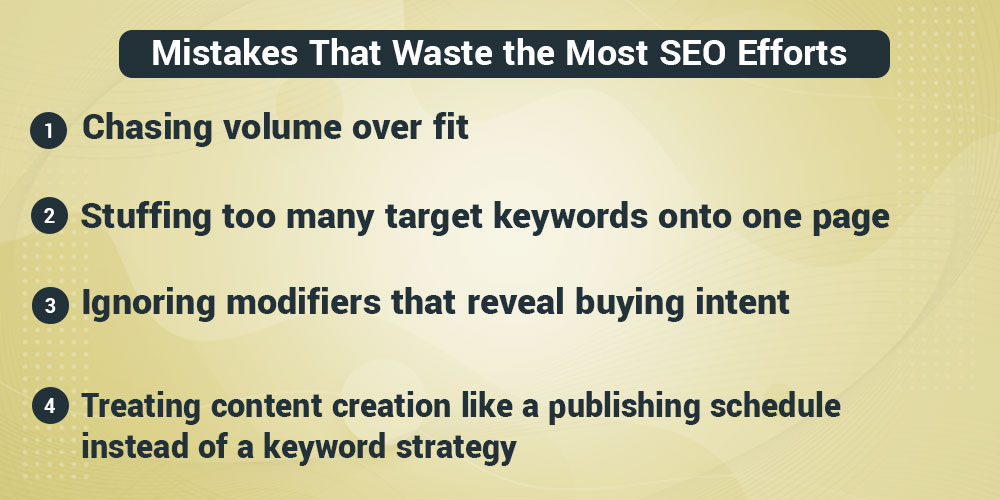
The first mistake is chasing volume over fit. Firms see a larger keyword, assume it will drive better results and ignore the fact that the audience is wrong. This is how traffic grows while lead quality stays flat.
The second mistake is stuffing too many target keywords onto one page. When a page tries to rank for tax planning, bookkeeping, payroll, audit support and advisory services all at once, the message gets blurry. Search engines struggle to interpret the primary topic and users struggle to see whether the page solves their problem.
The third mistake is ignoring modifiers that reveal buying intent. Geographic cues, industry terms, service descriptors and problem language are often where the value lives. Without those words, the page may attract broad impressions and weak click quality.
The fourth mistake is treating content creation like a publishing schedule instead of a keyword strategy. You do not need more articles just to fill the blog. You need pages that match how potential clients search, and you need those pages to use keywords naturally, build trust and move the visitor forward.
The fifth mistake is failing to separate educational content from conversion content. That is where firms lose the plot. Informational content has a role, but buyer-ready searches need pages designed to convert, not pages that wander for 1,500 words before mentioning the service.
Long-Tail Keywords Only Work Inside a Bigger SEO System
This is where many firms hit the ceiling. They find promising phrases, sprinkle them into copy and expect rankings to follow.
That is not how strong SEO works.
Long-tail keyword targeting is one layer inside a larger system. Once you find long-tail keywords, you still need the right page architecture, strong internal links, trust signals, local relevance and page experience. Google’s guidance on helpful, reliable, people-first content and page experience makes the point clearly. Relevance alone is not enough. The page also needs to be useful, credible and easy to use.
This is why the same keyword can produce very different results on different sites. One accounting firm may publish a thin page with a vague headline, weak proof and no local relevance. Another may build a clear page around searcher intent, build authority with expert messaging and make the next step obvious. Both can use the same phrase. Only one is likely to convert.
That is also why keyword research, on-page work, local optimization and trust-building need to cooperate. Long-tail phrases can help you attract more qualified traffic. They do not remove the need for better page design, stronger proof, clearer calls to action or deeper topical coverage.
The same logic now matters for AI SEO too. Search engines, AI systems and human readers all respond better when the page language matches a clear need. In accounting today, vague copy and fuzzy keyword targeting create a weaker signal everywhere. Long-tail targeting and building trust have to rise together.
How White Peak Uses This Thinking
At White Peak, we do not treat long tail keywords as a side task. We treat them as a qualification layer inside a revenue-focused SEO strategy.
That changes how we evaluate opportunity.
We look at how potential clients search, which queries signal urgency, which phrases belong on service pages, which belong in supporting content and which terms create noise instead of demand. Then we optimize your meta titles, headings, copy and internal links around intent, not just rankings. That is how you improve search engine rankings without filling the site with content that looks busy and sells nothing. If you want help applying that system, our SEO for Accountants service is built around tighter targeting, stronger page architecture and content that supports revenue.
For accounting professionals and CPAs, this matters even more because trust drives the click and the conversion. The searcher is not just asking whether you exist. They are asking whether your firm understands their business, their problem and their market. Long-tail phrases help you answer that question before the visit even begins.
If your current SEO efforts bring impressions but not consultations, the issue may not be visibility alone. It may be that your keyword strategy is too broad, your page mapping is off or your content is aimed at the wrong stage of the journey. In that case, the better move is not more traffic. It is better targeting.
That is one of the most reliable strategies to improve lead quality and boost your visibility with the right audience. A phrase like tax preparation services for small businesses will usually beat a vague head term. A modifier like tax preparation, an industry qualifier or a city name can turn a loose query into a high intent opportunity.
When you choose keywords for your accounting firm, do not ask only whether the phrase can rank. Ask whether the wording sounds like someone ready to hire, compare or book a consultation. That is the real test. And that is the real promise of long tail keywords for accountants. They help you stop writing for everyone, stop chasing empty ranking wins and start attracting people who are much closer to becoming clients.
50 Long-Tail Keywords for Accounting, Bookkeeping and CPA Firms
1. small business accounting services near me
2. bookkeeping services for small businesses in [city]
3. outsourced bookkeeping services for startups
4. virtual bookkeeping services for online businesses
5. best cpa firm for small business taxes
6. cpa for real estate investors in [city]
7. ecommerce bookkeeping services for Shopify stores
8. affordable bookkeeping services for freelancers
9. tax preparation for small business owners
10. payroll and bookkeeping services for restaurants
11. church accounting and bookkeeping services
12. nonprofit bookkeeping services in [city]
13. cpa for independent contractors and gig workers
14. quickbooks cleanup services for small businesses
15. monthly bookkeeping packages for small business
16. part‑time cfo services for growing companies
17. cpa specializing in s corp taxes
18. bookkeeping services for property management companies
19. tax planning services for high income earners
20. startup accounting and bookkeeping services
21. virtual cpa services for remote businesses
22. cpa for doctors and medical practices
23. bookkeeping services for construction companies
24. cloud bookkeeping services for xero users
25. bookkeeping and payroll services for salons
26. faith‑based bookkeeping services for churches and ministries
27. cpa for amazon fba and ecommerce sellers
28. forensic accounting services for small businesses
29. cpa for multi‑state small business taxes
30. bookkeeping services for consulting businesses
31. tax preparation services for retirees in [city]
32. cpa for cryptocurrency traders and investors
33. bookkeeping services for law firms in [city]
34. restaurant accounting and payroll services
35. bookkeeping services for landlords and rental properties
36. cpa firm specializing in irs problem resolution
37. quarterly tax planning services for small business
38. bookkeeping review and reconciliation services
39. online bookkeeping services with flat monthly fee
40. bookkeeping services for home‑based businesses
41. cpa for partnership tax returns in [city]
42. sales tax filing services for online sellers
43. bookkeeping services for marketing agencies
44. cpa for professional service firms (law, design, consulting)
45. bookkeeping and accounting services for nonprofits near me
46. christian cpa firm for churches and ministries
47. bookkeeping services for trucking and transportation companies
48. full service accounting and bookkeeping for small business
49. cpa for business entity selection and setup
50. bookkeeping services for fitness studios and gyms