Most accounting firms do not have a publishing problem. They have a structure problem.
That is why accounting website topic clusters matter. You can publish article after article, add more service copy, chase another keyword and still watch your rankings stall. Not because your team is lazy. Not because SEO is broken. Your site underperforms when the pages do not reinforce one another, your coverage stays fragmented and the relationship between your services, your expertise and your content is hard for both people and search engines to read.
If you want the broader system behind this, start with How SEO Works for Accounting Firms: A Full Breakdown. This article narrows in on one part of that system: content structure. More specifically, it shows you how to use accounting website topic clusters to turn scattered pages into a coherent ranking blueprint.
Key Takeaways
What structured SEO delivers:
- Clusters beat random publishing: Connected pages send clearer ranking signals.
- Each page needs a job: Pillars, support pages, and locals should work together.
- Internal links carry the weight: Relevance, context, and flow come from linking.
- Start with business value: Build the first cluster around a high-impact service.
Check out How SEO Works for Accounting Firms: A Full Breakdown.
Why Accounting Website Topic Clusters Work Better Than Random Publishing
A lot of accounting sites grow the same way. One tax article here. One bookkeeping page there. A city page gets added later. Then someone writes a post about deductions, another about payroll and another about year-end planning. Every piece of content may be decent on its own. The problem is that the site never becomes a unified signal to search engines.
Google’s own SEO Starter Guide says organizing your site logically helps search engines and users understand how pages relate to the rest of your site. That one idea does a lot of work. It explains why topic clusters instead of random publishing produce stronger SEO results.
A topic cluster is a content structure built around one central topic. You create a pillar page or other core page that covers the main topic at a high level. Then you build supporting content around that core topic, each page taking on a narrower job. One cluster page may answer a specific topic. Another may target a service variation. Another may address a buyer question. Through deliberate internal linking, those pages pass context, relevance and navigational clarity back and forth.
That is the real value of a content cluster. It is not a cute content marketing diagram. It is a method of content organization that helps you create topic clusters and pillar relationships around the services people actually hire accountants for.
Accounting firms benefit from this more than most. Buyers in this market do not always search with one broad topic in mind. They search by problem, urgency, business type, location and trust. One person looks for tax planning for contractors. Another wants outsourced CFO help for a growing company. Another needs bookkeeping cleanup before filing. When your content is created as isolated assets, that demand gets scattered. When content is built as interconnected content around a single topic or service line, topic coverage becomes clearer.
Topic clusters are not about writing more just to look busy. Topic clusters aren’t a volume game. They are a relevance game.
What a Topic Cluster Looks Like On an Accounting Website
Forget abstract theory for a minute. Picture one accounting service area as your first topic.
Let’s say the main topic is small business tax planning. Your pillar page and cluster could include a page that covers the service itself, a page for tax planning in a specific market, supporting content on quarterly estimates, entity selection, bookkeeping prep before tax season, common tax mistakes by business type and a page that covers when a business owner should move from basic compliance to proactive planning. That is one topic in depth, not ten unrelated content ideas.
Now the structure starts to work for you.
The service page carries commercial intent. The educational pages capture search queries from people still evaluating options. The location page strengthens local relevance. The supporting content fills content gaps around the same core topic. All of those pages in the cluster point back to the pillar page or main commercial page where appropriate, and they also connect laterally when the relationship helps the reader.
This is where topic clusters and pillar pages separate strong sites from busy sites. Each page has a role. Each keyword target has a home. Each piece of content strengthens the rest.
That is also why pillar pages for SEO work best when they are surrounded by purposeful cluster content. A pillar page without supporting content often stays thin. Supporting content without a pillar page and cluster system often floats around with no commercial center. Pillar pages and cluster content work when the architecture tells a clear story.
For accounting firms, cluster pages like these also make your expertise easier to demonstrate. You are not just claiming you understand a particular topic. You are building visible coverage of a topic through related content, service depth and page relationships.
How To Build Accounting Website Topic Clusters Around One Core Topic
Start with business priority, not blog inspiration.
Your first topic cluster should usually come from a high-value service line, a profitable audience segment or a core offer where better SEO results would create real pipeline. That could be tax planning, outsourced accounting, bookkeeping for contractors, audit support or advisory work. Pick a central topic where ranking matters to revenue.
Then audit what you already have. A content audit shows you the current content, the existing content that can be improved and the content gaps that still need to be filled. It also keeps you from creating content that competes with pages on your website that already exist. Google’s Search Console can help you review queries, pages and trends, while Google also recommends tools like keyword research tools like Google Keyword Planner when you need more keyword ideas and a clearer view of search volume.
Once you know the main topic, map the topic and subtopic layers. This is where many firms go vague. They pick one broad topic, then keep publishing around it without deciding what belongs on the pillar content, what belongs on supporting pages and what should not be created at all.
A cleaner model looks like this:
- one pillar page or core commercial page for the main topic
- supporting content for closely related questions, modifiers and use cases
- local or niche pages where geographic or audience intent changes the page purpose
- trust-building pages or body content enhancements that make the whole section more believable
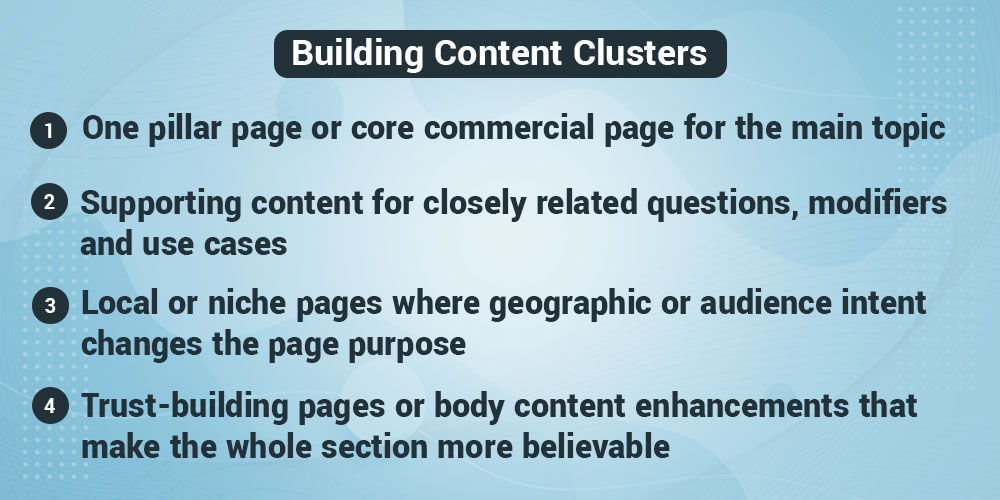
That is how you create topic clusters and pillar relationships with intent.
A few questions keep the structure honest. Is this page targeting a specific topic that deserves its own URL? Does it support the central topic or does it drift into a different cluster? Should it send people back to the pillar page, or does it belong closer to another service area? Will this one piece of content strengthen coverage of a topic, or dilute it?
When you can answer those questions clearly, your topic cluster strategy starts to take shape.
What Strong Topic Cluster Content Actually Does
A lot of people hear “cluster content” and think blog posts.
That is too narrow.
Topic cluster content can include service expansions, local pages, industry pages, buying-stage education and FAQ-driven assets that address a particular topic from different angles. The goal is not to create topic clusters for every possible phrase. The goal is to build content around core commercial themes in a way that matches how buyers research.
That distinction matters because accounting buyers rarely move in a straight line. They bounce between questions. They compare providers. They sanity-check credibility. They look for fit. One page that covers everything badly will not do that work. Several pages that each handle one part of the decision process can.
This is why a smart content strategy beats scattered content marketing every time. One piece of content can answer a narrow question. A cluster can support a full decision path. Clusters also simplify your content planning because they force you to define the job of each page before the writing starts.
The best topic cluster examples are not the biggest. They are the clearest.
Why Internal Linking Does the Heavy Lifting

You can have a clean content strategy on paper and still waste it with weak internal linking.
Google states in its link best practices that it uses links as a signal when determining the relevancy of pages and to find new pages to crawl. That means internal linking is not decoration. It is part of how your site communicates relationships.
Anchor text matters. Placement matters. Relevance matters.
If your tax planning page links to a helpful article on estimated payments, and that article links back to the service page with context, you are creating a usable path for readers and a stronger signal to search engines. If your pages in the cluster never connect, or they all link with vague anchor text, the architecture goes quiet.
Google’s guidance on sitelinks also points to logical site structure, informative headings and relevant internal links as factors that help its systems surface better shortcuts for users. You cannot force that outcome. You can build the kind of structure that deserves it.
This is where many accounting sites come apart. They publish a cluster page, then forget to link it from the right service page. They link back to the pillar page once and call it done. They ignore related content that should be connected. Or they bury useful pages three clicks deep where neither users nor crawlers get strong context.
Internal linking should do three jobs at once. It should help a reader move to the next logical page, help search engines understand which pages belong together and help your most important commercial pages gain support from relevant content around them.
If your cluster has no connective tissue, it is not really a cluster.
The Biggest Mistakes In Topic Cluster Strategy
The first mistake is treating every keyword like a separate campaign.
That approach creates duplicated intent, overlapping pages and cannibalization. Instead of building content around one central topic, firms spin out disconnected URLs for every slight keyword variation. More pages get created. Less clarity gets created.
The second mistake is choosing the wrong page type.
A high-intent phrase may belong on a service page, not in a blog post. A local modifier may need a localized page, not a paragraph stuffed into generic body content. An educational search may deserve supporting content that warms the visitor up before routing them to a service offer. If you mismatch the keyword and the page type, the structure gets muddy fast.
The third mistake is confusing content creation with content architecture.
Creating content is not the same as building content around a coherent core topic. A content marketing strategy can produce a lot of motion with very little compounding value if each piece of content lives alone. A topic cluster model forces your content creation process to answer a harder question: where does this page fit inside the larger system?
The fourth mistake is overbuilding.
You do not need fifty pages before your cluster works. In fact, trying to create topic clusters around every service line at once usually leads to thin pages, rushed body content and messy decisions. Strong topic clusters begin with one high-impact content area, then expand as the structure proves itself.
Why Topic Clusters Matter In a Trust-Heavy Category Like Accounting
Accounting is not a casual purchase. People make financial decisions based on what they read, who they trust and how credible the firm appears.
Google says its systems give more weight to strong E-E-A-T for topics that could significantly impact the health, financial stability, or safety of people, or the welfare or well-being of society.
That does not mean a topic cluster by itself will make you rank. It does mean the way you organize and support your information cannot be sloppy.
A clean cluster helps on two fronts. First, it improves content structure and topic coverage, which makes your site easier to interpret. Second, it gives you more room to publish quality content and high-quality content that proves expertise across the full buyer journey.
This is where topic clusters and pillar pages become more than an SEO tactic. They become trust architecture.
A buyer lands on one article, then sees a deeper related page. They reach a stronger service page. They find useful related content, clear navigation and a site that feels like it actually understands the topic in depth. That sequence changes how the firm is perceived.
Trust grows when the structure feels intentional.
Topic Clusters, Google Search and AI Discovery
Search behavior is stretching. Classic search engine results pages still matter, but they are not the only place people discover expertise now.
OpenAI says ChatGPT can now search the web and get fast, timely answers with links to relevant web sources, and OpenAI also tells publishers to allow OAI-SearchBot if they want their sites to be discoverable in ChatGPT search. That does not create a new excuse for fluffy publishing. It raises the bar for organizing content that’s easy to crawl, easy to cite and easy to interpret page by page.

This is where several SEO strategies start to converge. Logical content structure helps users. Relevant links help crawlers. Helpful pages with a clear primary purpose help search visibility. Google’s guidance on people-first content makes that point plainly.
So, do topic clusters guarantee visibility in Google or ChatGPT? No.
Do clusters provide a stronger framework for showing what your site knows, how your pages relate and where authority sits? Yes. That is the practical case for topic pillars in 2026. They help organize content around core services in a way that is easier to scale and easier to trust.
How To Prioritize Your First Cluster Without Creating a Mess
Start where the commercial upside is highest.
If you are an accounting firm with several SEO opportunities, do not begin with the loudest internal opinion or the most glamorous content ideas. Begin with the service line where better visibility would produce the clearest business impact. Then create a content structure around that offer.
For most firms, the sequence should look something like this. Pick the service. Identify the main topic and the topic and subtopic layers around it. Decide which page will act as the pillar content or core commercial destination. Map the supporting content needed to create coverage of a topic. Then phase the rollout so the pages support one another from day one.
That is a far better way to create topic than chasing random demand spikes.
It also helps you avoid another common trap. Many firms think they need separate clusters for every tiny keyword. They do not. One effective topic cluster can target one topic in depth while still capturing several SEO opportunities through well-mapped supporting content.
That is how you simplify your content without dumbing it down.
When a Firm Should Bring In SEO Experts
You can learn how topic clusters work on your own. You can even sketch your first cluster with a spreadsheet and a solid content strategy.
The trouble starts when structure decisions begin affecting revenue.
Now you are no longer deciding between content ideas. You are deciding which page gets the strongest intent, where to send authority, how to prevent overlap, how to align internal linking, how to support trust signals and how to make sure the content you create actually supports qualified lead flow. That is deeper than a method of content planning. It becomes search engine optimization strategy.
This is where many firms stall. Not because they cannot create a content outline. Because they need an effective topic system that balances search demand, buyer intent, page purpose and business value at the same time.
That is the kind of work we do at White Peak. We help accounting firms in Reno, Sparks, Carson City, Truckee and nationwide turn broad SEO ambitions into high-impact content systems with clear topic coverage, clean internal linking and pages built to support growth.
If your team is staring at scattered content, overlapping pages and uncertain next steps, accounting website topic clusters are the right place to bring order back into the system. Build them with intent, connect them with purpose and your website starts acting less like a brochure and more like a ranking asset.