EEAT for accounting firms is not a branding flourish. It is the framework Google uses to judge whether your site deserves search visibility in a category tied to money, risk and trust. If you want to rank in Google, appear in AI answers and build trust faster, your content has to prove far more than basic competence.
Accounting falls inside Google’s your money or your life category. When a page can influence financial decisions, compliance steps or tax outcomes, Google applies a tougher standard. Thin content, vague claims and anonymous authorship drag down trustworthiness fast.
A lot of accounting firms miss that point.
They publish service pages, add a few articles and hope SEO will reward volume. Then rankings stall, search results stay crowded and the site never earns the kind of visibility that turns into qualified leads.
The missing piece is often E-E-A-T.
Key Takeaways
What accounting EEAT demands:
- YMYL raises the bar: Finance pages need stronger trust signals.
- EEAT must be visible: Show experts, bios, proof, and clear services.
- Site-wide trust matters: About, contact, reviews, and links all count.
- Audit before scaling: More content fails if credibility gaps stay hidden.
Our team see accounting firms with deep expertise, strong client relationships, and years of real-world work still struggling to get found. Their issue is not a lack of substance. Their issue is that the site does not surface enough authority signals, proof or credible context for search engines and users to evaluate.
Google and AI can only judge what you make visible. If your accounting firm hides the very evidence that makes you trustworthy, your ranking ceiling stays low, no matter how polished the design looks.
Why EEAT for Accounting Firms Affects Ranking and Visibility
“E‑A‑T, that template, of how we rate an individual site based on expertise, authoritativeness and trustworthiness, we do it to every single query and every single result. So it is actually pretty pervasive throughout everything we do.”
E-E-A-T stands for experience, expertise, authoritativeness and trustworthiness. In practical terms, it is Google’s way of asking whether your content came from people who know what they are talking about, whether they have real-world experience and whether the site feels safe to trust.
That matters more in accounting than in lighter industries. When someone searches for tax planning guidance, audit preparation steps or bookkeeping help, they are not browsing for entertainment. They are looking for advice that may affect filings, cash flow, risk exposure and legal obligations.
Google’s guidance on creating helpful, reliable, people-first content makes that direction clear. Helpful content is not just readable. It has to show substance, clarity and a reason to believe the person behind it knows the subject.
This is where the conversation around ranking factor gets muddy. E-E-A-T is not one toggle that Google flips on or off. It is the quality framework behind how Google uses many signals to evaluate pages, domains and entities. If you want the broader context for how those signals work together across your site, read How SEO Works for Accounting Firms: A Full Breakdown.
That distinction changes how you work.
E-E-A-T Isn’t a Quick Fix
If you think of E-E-A-T as a single ranking factor, you will look for hacks. If you understand it as the standard behind assessing content quality, trust signals and authority signals, you start fixing the pieces that actually influence ranking and visibility.
Google added the extra E for experience in its update on E-E-A-T. That change matters for accountants because real-world experience is often what separates usable advice from empty explanation. A page should sound like it was written by people who have handled the work, not by someone paraphrasing search results.
Professional service firms can build stronger search visibility when they stop writing like generic publishers and start publishing like accountable experts. For an accounting practice, that means your content should reflect how you actually evaluate risk, explain tradeoffs and guide clients through messy situations.
How EEAT for Accounting Firms Shows Up on the Page
Strong EEAT for accounting firms is visible. You can point to it on the page without squinting.
A serious article has a real author. That person has a bio. The bio includes a relevant credential, role, or history that directly connects to the topic. If the page discusses tax strategy, financial reporting or an audit process, the author should look qualified to address it.
That sounds obvious, but firms ignore it all the time.
A named accountant, reviewer or subject matter contributor does more than fill space. It helps search engines understand who created the content and helps readers decide whether they trust the guidance. Anonymous thought leadership on a YMYL page is a bad look.
A strong page also carries evidence. That can include case studies, client stories, a testimonial, speaking experience, association memberships, press mentions, awards or references to credible sources. When credible sources support your explanation, your content looks grounded rather than promotional.
This is also where real-world language matters. Accounting buyers are not looking for inflated prose about “custom solutions for modern businesses.” They want signs that your accountant understands deadlines, compliance pressure, reporting complexity and the consequences of getting details wrong.
Your service pages need the same discipline. If you offer tax advisory, payroll services, bookkeeping cleanups or outsourced CFO work, say so plainly. Explain who the service is for, what problems it solves and what outcome the client can expect. That clarity improves SEO and trustworthiness at the same time.
What Google Uses to Evaluate Trustworthiness

Google uses more than the words inside one article. It looks at the page, the site as a whole and your reputation across the web. That means one polished blog post cannot rescue an accounting firm whose broader digital presence looks thin, vague or inconsistent.
Google’s quality rater guidelines spend a lot of time on who is responsible for the content and the website. For an accounting firm, that means your About page, Contact page and team pages are not side characters. They are part of the trust infrastructure.
If your legal business name, service areas, office details or leadership information are hard to find, trust erodes. Search engines do not enjoy guessing, and people who are looking to build a relationship with a financial advisor do not enjoy it either.
Authorship comes next. High-stakes pages should not float around with no accountable expert attached. If a tax article is published under a vague admin profile with no bio, no credential and no context, that page starts in a hole.
Reputation matters too. Google’s local guidance explains that information from across the web, including how many websites link to your business, contributes to prominence. Reviews and ratings can support that picture as well, which is why your reputation across the web is part of search visibility, not separate from it.
Backlinks still matter because they help search engines evaluate whether others view your firm as authoritative. One relevant backlink from a respected accounting association, university or business publication can say more than a pile of low-value directory links that exist only to impersonate credibility.
On-page trust signals carry weight too. Use publication dates where they help. Show review dates on sensitive content. Link to IRS and other authoritative sources when making technical claims. Make bios easy to find. Connect articles to real service lines. Give search engines and users enough data points to evaluate your firm without friction.
Schema markup belongs in this discussion because structured data helps Google understand entities and page relationships. It does not create trust on its own, though it helps search engines connect who wrote the page, what the page covers and how the site is organized.
For content pages, Article structured data can reinforce authorship and page details. At the brand level, Organization structured data helps define core business information that supports clearer interpretation.
Run an E-E-A-T Audit Before You Publish More
If your site has weak E-E-A-T signals, publishing more pages will not solve the problem. It will multiply it. That is why an E-E-A-T audit should happen before your next major content push, not after six more articles have already gone live.
“Our systems give even more weight to content that aligns with strong E‑E‑A‑T (expertise, experience, authoritativeness, and trustworthiness).”
An E-E-A-T audit should evaluate your revenue pages, educational content and firm-level trust pages together. You are looking for the gap between what your accounting firm knows and what your website proves.
Start with your high-stakes pages. Look at service pages, tax content, advisory pages and any article that touches compliance, reporting or financial decisions. Ask whether the author is visible, whether the topic matches the author’s expertise and whether the page includes verifiable proof.
Then look at the site as a whole. Does the firm appear established? Are bios easy to reach? Does your About page communicate who leads the work? Are contact details complete? Do your team pages feel current or do they look like they were abandoned three redesigns ago?
A useful E-E-A-T audit should cover these checks:
- named author or reviewer on high-stakes pages
- bio tied to a relevant credential or role
- case studies or client stories that are specific and verifiable
- internal links connecting bios, services and educational content
- authority signals from associations, media or speaking experience
- schema markup that supports organization and article entities
- outdated pages that need review, consolidation or removal
- AI-generated content that lacks substance or editorial control
Audits provide a clear direction because they show where credibility breaks down. Sometimes the issue is page-level weakness. Sometimes the site as a whole looks too anonymous. In many firms, both problems are working together like a cheerful little sabotage team.
Google and AI Search Are Evaluating the Same Core Signals
Google and AI are moving toward the same question: who deserves to be believed?
Google’s guidance on AI features and your website says the same best practices that support Google search also support AI overviews and AI mode. That means Google and AI are not two separate games with opposite rules. They reward many of the same trust signals.
If you want to get cited in Google’s AI overview, show up in AI answers or improve visibility across AI search platforms, your content has to be easier to parse, verify and trust. That means clear structure, strong entity signals, authoritativeness and useful evidence.
This is where AI search changes the stakes. Tools like ChatGPT and Perplexity pull from web content and synthesize answers. Google’s AI systems do similar work inside search. When your site is vague, generic or lightly sourced, you make it harder for those systems to use you as a credible source.
That does not mean you should write for robots.
It means you should write with enough clarity and proof that machines and humans arrive at the same conclusion. This firm knows the subject. This page is credible. This content is worth citing.
Schema markup helps AI understand those relationships more cleanly. It also helps AI models connect entities across your site, which supports better interpretation of who your accounting firm is and what each page contributes.
What is Schema markup?
Schema markup is structured data code that labels the entities on a page (like products, articles, reviews) so search engines better understand the content and can show rich results.
Check out our complete “What Is Schema Markup?” guide.
AI tools can help with workflow, but they do not replace expertise. Google’s guidance on using generative AI content does not forbid AI-generated content. It warns against scaled, low-value content that exists mainly to game search results.
That warning matters for accounting firms because YMYL content breaks trust fast when it sounds polished but empty. If a page feels AI-generated, unsupported and disconnected from genuine expertise, the problem is not the software. The problem is editorial negligence.
How Accounting Firms Build Authority without Sounding Generic
Authority does not come from saying you are authoritative. That move lands with all the elegance of a fake Rolex in fluorescent lighting.
Authority comes from specificity. You build authority when you explain a precise issue, tie it to real-world work and support your claims with credible sources, proof and accountable authorship. A generic page can mention SEO, AI search and ranking all day and still fail to build trust.
Your bios are a big part of this. A bio should not read like filler tacked onto the page because someone remembered E-E-A-T at the last second. It should explain who the person is, what they do, what kind of businesses they help and why their perspective matters.
Client proof should match the topic. If the page is about advisory services, use case studies or client stories that show strategic work. If the page is about bookkeeping cleanup or audit support, your proof should reflect accuracy, process and responsiveness. One floating testimonial about “great service” will not do much heavy lifting.
You should also surface authority across the web. Mentions from business publications, trade associations, conference appearances and respected local organizations strengthen your reputation. Those mentions become authority signals because they show your accounting firm is recognized beyond its own website.
This is also where backlink strategy gets more mature. A backlink from a relevant source says more than ten random links from places no serious buyer would ever read. Search engines and users both respond to quality cues, and backlinks are still one of those cues.
Local reputation belongs in the mix, too. Google notes that more reviews and positive ratings can support local prominence. If your firm serves Reno, Sparks, Carson City or Truckee, that local trust layer can reinforce what your website is already trying to prove.
Where Firms Get EEAT Wrong
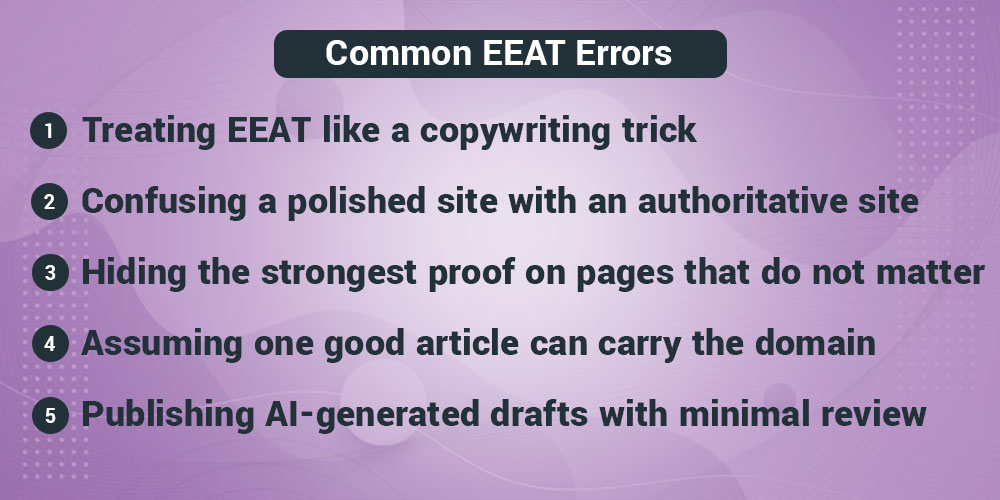
The first mistake is treating EEAT like a copywriting trick. Better wording helps, but wording alone does not create trustworthiness. Proof creates trustworthiness.
The second mistake is confusing a polished site with an authoritative site. Clean design helps, though a beautiful page with no author, no bio and no evidence still looks hollow.
The third mistake is hiding the strongest proof on pages that do not matter. We see accounting firm sites where the best credential details live on a lonely team page while service pages stay bland and generic. That arrangement wastes authority.
The fourth mistake is assuming one good article can carry the rest of the domain. It cannot. Google uses signals from the site as a whole, which means weak pages, thin bios and poor reputation can dilute stronger content.
The fifth mistake is publishing AI-generated drafts with minimal review. In a YMYL category, that can damage trust fast. Whether your content performs comes down to whether it reflects genuine expertise and whether the claims are verifiable.
Measure Whether E-E-A-T Improvements Are Working
Trust needs to show up in performance. If your site looks more credible but search visibility does not improve, something is still broken.
Use Google Search Console to track impressions, clicks, query trends and page movement in Google search. Watch how service pages and educational pages respond after you strengthen bios, improve internal linking and add better authority signals.
Pair that with Google Analytics so you can evaluate what happens after the click. Better rankings are useful, but they are not the whole point. You need to see whether users engage more deeply, convert more often and move toward contact actions with less hesitation.
These are strong data points to watch:
- nonbranded impressions for commercial pages
- clicks from high-intent keyword queries
- lead actions from service pages
- assisted conversions from educational content
- growth in branded search volume
- new authoritative backlinks and mentions
Do not get distracted by traffic that looks impressive in a dashboard but has no commercial value. An accounting firm does not need random visitors. It needs search visibility with the right audience, stronger trust signals and content that helps qualified buyers choose with confidence.
That is why EEAT for accounting firms deserves more attention than another round of generic blogging. When your site makes genuine expertise, real-world experience, authoritativeness and trustworthiness easy to evaluate, you improve how Google search, AI search and potential clients read your business. That shift will help your accounting firm get found, build authority and earn the kind of visibility that compounds.